

The specification of a 10K3A1 temperature sensor
A 10K3A1 temperature sensor is a 10 kΩ NTC thermistor commonly used in HVAC/BMS applications. The designation generally refers to the 10K Type 3 / 3A1 thermistor curve.
| Specification | 10K3A1 |
|---|---|
| Sensor type | NTC thermistor |
| Nominal resistance | 10,000 Ω at 25°C (77°F) |
| Resistance characteristic | Resistance decreases as temperature increases |
| Nominal Beta (β) value | ≈ 3976 K |
| Common designation | 10K Type 3 / 10K3A1 |
| Reference temperature | 25°C |
| Typical operating range | Approximately −40°C to +125°C, depending on sensor construction |
| Typical accuracy | Usually ±0.2°C to ±0.5°C around normal HVAC temperatures, depending on the manufacturer |
| BMS input | Passive resistive / thermistor input |
| Polarity | None |
Typical 10K3A1 resistance values
Approximate values useful for BMS commissioning and fault finding are:
| Temperature | Approx. Resistance |
|---|---|
| −20°C | 96.8 kΩ |
| −10°C | 55.3 kΩ |
| 0°C | 32.6 kΩ |
| 5°C | 25.4 kΩ |
| 10°C | 19.9 kΩ |
| 15°C | 15.7 kΩ |
| 20°C | 12.5 kΩ |
| 25°C | 10.0 kΩ |
| 30°C | 8.06 kΩ |
| 35°C | 6.53 kΩ |
| 40°C | 5.33 kΩ |
| 50°C | 3.60 kΩ |
| 60°C | 2.49 kΩ |
| 70°C | 1.76 kΩ |
| 80°C | 1.27 kΩ |
| 90°C | 0.93 kΩ |
| 100°C | 0.70 kΩ |
For Tridium Niagara N4
For an N4 controller/input configured for a 10K3A1 thermistor, the important characteristics are:
R25 = 10,000 Ω
Beta ≈ 3976 K
One important point: 10K thermistors are not interchangeable just because they all measure 10 kΩ at 25°C. A 10K Type 2, Type 3/3A1 and other 10K curves can produce significantly different temperatures away from 25°C. For a BMS specification, I would therefore specify “10 kΩ NTC, Type 3/3A1 characteristic, R25 = 10 kΩ” rather than simply “10K thermistor.”
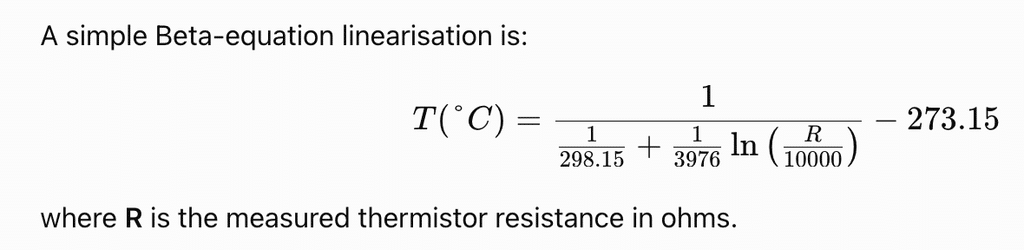
Below is the full 10K3A1 resistance/temperature table from −40°C to +120°C in 1°C increments, calculated using:

| Temp °C | Resistance Ω | Temp °C | Resistance Ω |
|---|---|---|---|
| -40 | 411,749 | 41 | 5,070 |
| -39 | 382,827 | 42 | 4,871 |
| -38 | 356,157 | 43 | 4,680 |
| -37 | 331,548 | 44 | 4,498 |
| -36 | 308,825 | 45 | 4,324 |
| -35 | 287,832 | 46 | 4,158 |
| -34 | 268,423 | 47 | 4,000 |
| -33 | 250,469 | 48 | 3,848 |
| -32 | 233,850 | 49 | 3,703 |
| -31 | 218,457 | 50 | 3,564 |
| -30 | 204,192 | 51 | 3,431 |
| -29 | 190,964 | 52 | 3,304 |
| -28 | 178,691 | 53 | 3,183 |
| -27 | 167,297 | 54 | 3,066 |
| -26 | 156,712 | 55 | 2,955 |
| -25 | 146,875 | 56 | 2,848 |
| -24 | 137,727 | 57 | 2,746 |
| -23 | 129,215 | 58 | 2,648 |
| -22 | 121,291 | 59 | 2,554 |
| -21 | 113,910 | 60 | 2,463 |
| -20 | 107,031 | 61 | 2,377 |
| -19 | 100,617 | 62 | 2,294 |
| -18 | 94,633 | 63 | 2,215 |
| -17 | 89,048 | 64 | 2,138 |
| -16 | 83,831 | 65 | 2,065 |
| -15 | 78,958 | 66 | 1,995 |
| -14 | 74,402 | 67 | 1,927 |
| -13 | 70,141 | 68 | 1,862 |
| -12 | 66,154 | 69 | 1,800 |
| -11 | 62,421 | 70 | 1,740 |
| -10 | 58,925 | 71 | 1,682 |
| -9 | 55,649 | 72 | 1,627 |
| -8 | 52,578 | 73 | 1,574 |
| -7 | 49,698 | 74 | 1,522 |
| -6 | 46,995 | 75 | 1,473 |
| -5 | 44,458 | 76 | 1,426 |
| -4 | 42,075 | 77 | 1,380 |
| -3 | 39,836 | 78 | 1,336 |
| -2 | 37,731 | 79 | 1,294 |
| -1 | 35,752 | 80 | 1,253 |
| 0 | 33,890 | 81 | 1,214 |
| 1 | 32,138 | 82 | 1,176 |
| 2 | 30,487 | 83 | 1,140 |
| 3 | 28,933 | 84 | 1,105 |
| 4 | 27,468 | 85 | 1,071 |
| 5 | 26,088 | 86 | 1,038 |
| 6 | 24,785 | 87 | 1,007 |
| 7 | 23,557 | 88 | 977 |
| 8 | 22,397 | 89 | 947 |
| 9 | 21,302 | 90 | 919 |
| 10 | 20,268 | 91 | 892 |
| 11 | 19,291 | 92 | 866 |
| 12 | 18,367 | 93 | 840 |
| 13 | 17,493 | 94 | 816 |
| 14 | 16,667 | 95 | 792 |
| 15 | 15,885 | 96 | 769 |
| 16 | 15,145 | 97 | 747 |
| 17 | 14,444 | 98 | 726 |
| 18 | 13,780 | 99 | 705 |
| 19 | 13,151 | 100 | 685 |
| 20 | 12,554 | 101 | 666 |
| 21 | 11,988 | 102 | 648 |
| 22 | 11,452 | 103 | 630 |
| 23 | 10,942 | 104 | 612 |
| 24 | 10,459 | 105 | 595 |
| 25 | 10,000 | 106 | 579 |
| 26 | 9,564 | 107 | 563 |
| 27 | 9,150 | 108 | 548 |
| 28 | 8,756 | 109 | 533 |
| 29 | 8,382 | 110 | 519 |
| 30 | 8,026 | 111 | 505 |
| 31 | 7,687 | 112 | 492 |
| 32 | 7,365 | 113 | 479 |
| 33 | 7,058 | 114 | 466 |
| 34 | 6,765 | 115 | 454 |
| 35 | 6,487 | 116 | 442 |
| 36 | 6,222 | 117 | 431 |
| 37 | 5,969 | 118 | 420 |
| 38 | 5,728 | 119 | 409 |
| 39 | 5,499 | 120 | 399 |
| 40 | 5,279 |
For Niagara N4 / BMS commissioning, some useful checkpoints from this calculated curve are:
0°C = 33.89 kΩ
10°C = 20.27 kΩ
20°C = 12.55 kΩ
25°C = 10.00 kΩ
30°C = 8.03 kΩ
40°C = 5.28 kΩ
50°C = 3.56 kΩ
60°C = 2.46 kΩ
70°C = 1.74 kΩ
80°C = 1.25 kΩ
90°C = 919 Ω
100°C = 685 Ω
One caution: this is a Beta-equation calculation using β = 3976 K. A manufacturer’s official 10K3A1 thermistor curve may use Steinhart-Hart coefficients or a resistance lookup table, so small differences are possible, especially at the extremes of the temperature range.